
ERPAIIntegration
Questions we answer
Can we trust AI to act on its own?Governance and guardrailsWho allowed the AI to do that?Identity travels with every requestCan someone talk the AI into something risky?Risk-graded autonomyCan we see who did what, and why?One thread from request to resultWhere are the keys kept?One vault, no shared secretsWhy did the AI bill jump, and who spent it?One counted doorwayIs every task getting the right model?Right model, right taskWhat if our AI vendor goes down or raises its price?No single point of supplyAre we paying for tools that do the same job?One tool per jobDoes the AI forget everything between conversations?Governed shared memoryIs this producing real work, or just answers?The digital factoryWhich work should run itself?Managed, not scriptedCan we get more from the Copilot licences we already pay for?Copilot proposes, the platform verifiesWill people actually use it?Meet people where they workHow much time do people lose sorting inbound information?Intake to insight, untouchedCan the same platform run a real business?One governed foundation for every productWhat happens when it breaks at night?Detect, fix, escalateWhere is the list of what is open, and who owns it?One list, closed with evidenceCould we recover if we lost everything?Proven by restoringCan you prove it to an auditor?Challenge before acceptanceDoes it get better over time, or just older?Every lesson becomes a ruleWill this still work after the next upgrade?Clean Core for AIDo our documents match what is actually running?Documentation as a by-product

Portfolio / Run Like an Enterprise

The business question · Incident and task management

“Where is the list of what is open, and who owns it?”

The concept

One list, closed with evidence

Incidents and tasks share one board, and nothing closes without proof.

How it works
Every incident opens a linked task on one board, every task has an owner, and nothing closes without evidence of the fix.
Why it matters
Leadership sees one honest picture of open work, and AI fits the service management you already run.
The result
There is one place to see what is open, who owns it and what proves it is done.

See it workingOne list, closed with evidenceReal screen

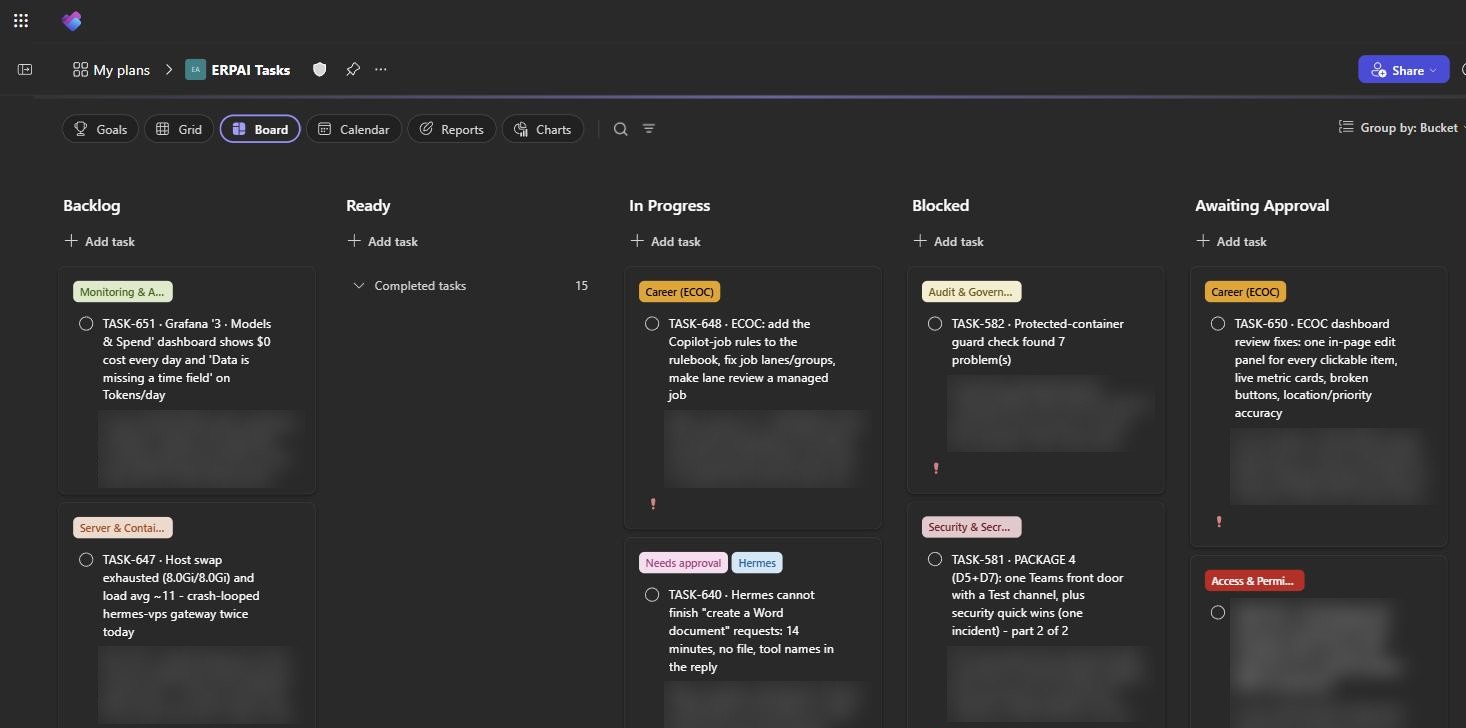
The live ERPAI Tasks board in Microsoft Planner
The real board in Microsoft Planner: one task list for every person and agent. Card details are blurred.

The business problem

Open work was scattered across chats, notes and lists.

In most programs, open work is scattered across tickets, chats, spreadsheets and people's memories. Findings, fixes and follow-ups were spread across chats, notes, several lists and a register, so nobody could see the whole picture.

Why this concept

One incident system and one task board, linked to each other

One list is the only list anyone trusts; linking incidents to tasks means no problem is fixed without a record.

Also considered

  • Keep each team's own list

How it works

One list, closed with evidence

Incident

Opened automatically

Linked task

On the one board

Owner

Every task has one

Evidence

Required before it closes

Result

One honest picture of open work

What we put in place

  • Moved every piece of open work onto one Microsoft Planner board, labelled by area.
  • Linked every change that is not self-healing to an incident and a task.
  • Wrote one short incident document for major changes only, so the record stays useful, not bulky.
  • Made tasks close only with evidence of what was made to happen and what was observed.

The result

Before

Open work was scattered across chats, notes and lists.

After

There is one place to see what is open, who owns it and what proves it is done.

I run AI work with the same service-management discipline as any enterprise program.

In your organization

AI work that fits your existing service management, not a parallel world.

Contact

Looking for someone to lead AI from pilot to production?

I would be glad to walk you through any part of this live and talk about the role you have in mind.

j.walters@erpaiintegration.com

Go deeper: Lessons · The journey · How it’s built · Live health